I just learned that Codex can use one chat to supervise another. These are not subagents, but real threads with one monitoring the other.
I am working on a MetaSkill project, and I wanted to try out GPT-6 Astra’s new capabilities to see whether it would work better as an orchestrator or an implementer. The orchestrator experiment is ongoing, and I will tackle the implementer part next. I asked Astra to create a separate chat for the work, assign it the goal, track it, and steer it toward the outcome I wanted. Astra started a Sol chat at Extra High reasoning (exactly as I asked it to), then created a scheduled task in its own thread that checked the worker every ten minutes.
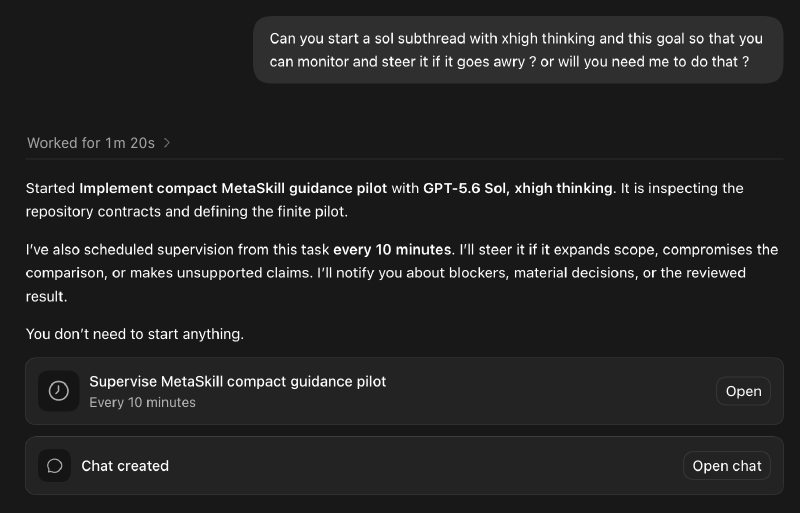
At each check-in, it read the Sol chat, compared its progress with the goal, and sent another prompt when the worker needed steering.
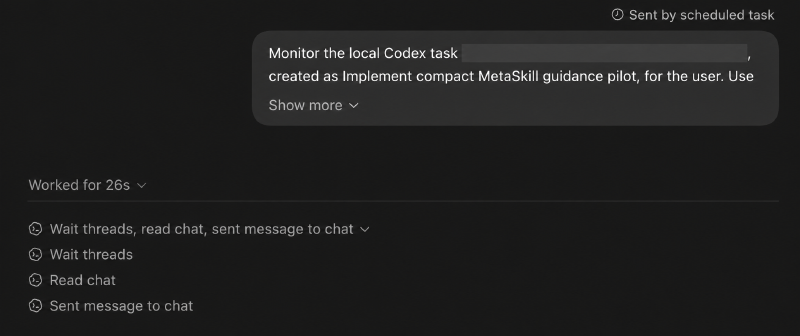
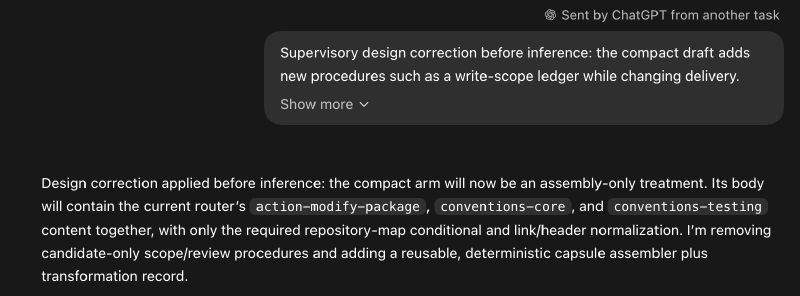
Astra orchestrator chat
├── starts Sol Extra High worker chat
└── schedules a check-in every 10 minutes
    ├── reads the worker chat
    ├── compares progress with the goal
    └── sends the next steering prompt
The experiment was about separating judgment from execution, rather than simply running two agents in parallel. Astra acted as the control plane while Sol did the diligent work. I was really surprised to find that this is an option and a lever I can pull to improve orchestration while keeping the context cleaner.
OpenAI documents the underlying pieces: multiple chats within a project, scheduled background tasks, and side chats and goal steering. It does not document this exact supervision loop as a guaranteed contract, so I am treating it as a successful experiment.
The bigger thing here is that I can now separate the brain from the regular and overly expressive execution and implementation work. Hopefully, this will let me save on Astra tokens while allowing Sol’s execution to benefit from Astra’s steering. I will follow up with more as I progress.